Showing posts with label volleyball positions. Show all posts

Sunday, November 15, 2015

HIT Me Baby (One More Time)!

The server goes to the backline. She slowly bounces the ball a few times, waiting for the referee to signal for her. Once the whistle is blown, she gives it a nice, low toss, and floats the ball into the left back corner on the opposing side. The libero, who is stationed there for that rotation of serve-receive, gives a beautiful pass to the front right position, where the setter had released to just seconds earlier. Her fingers rap around the edges of the ball as it reaches her forehand. She then pushes a gorgeous set to the outside. Now, it's all up to-

the hitter.

Ah yes, the hitter. Or as many of you may know her as, the spiker (which is not what the position is really called, but you are forgiven for your ignorance, for now). The hitter is undoubtedly the position on the court that receives the most glory and credit, and in some ways, this recognition is well-deserved. 


The hitter is the main, and I guess you could say only, offensive position on the team. Their job is to try to hit the ball so that the other team cannot get a good pass, so that their team wins the point. However, hitters do not just play offense. They are also an important part of the defense as well. When the hitters on the other team go up to hit, the hitters on the opposing team jump up at the net and use their hands as an extra barrier to try to stop the ball from ever reaching their side of the net. This is called a block. 


Although it may seem as though being a hitter is a fairly easy position to play, it's not. Many people think the only thing you need to be a hitter is the genetic quality of being tall, but this is not the case. Yes, if you are on the taller side, it is easier for coaches to train you to be a good hitter. However, I have played against many hitters in my day that if you saw in passing, you would probably qualify as rather short, around 5'5" or 5'6". 

There is a lot more that goes into being a hitter than simply your height. Another misconception about hitting is that to be successful in that position, you need to have above-average strength. Again, this is not the case. Often, a smart hit is going to be much more effective than a hard-as-you-can hit. Hitters need to be able to assess what is happening on the other side of the court and decide where the most effective spot to place the ball would be. 


Unlike liberos and setters, where there is one or at most two of them on the court at a time, there are always at least three hitters on the court at a time. There is the outside, who hits from the left front position, the middle, who hits from the middle front position, and the right side, who hits from the right front position. With three different offensive players in the front row, there are many different plays and sets that can be run to try to get a kill, but I'll go over those in my next blog.

Until then, it you want to learn more about hitters and how they contribute to the game of volleyball, you can read about it here. And with that, we've now completed the sequence of bump, set, and spike! Woohoo! It's been a KILL-er run if you ask me. ;) Come back next week so we can really DIVE into the game of volleyball!



Sunday, October 25, 2015

The Court of the Sport

Okay, since my last couple of posts have been more on the philosophical part of volleyball, I thought this week I would focus on something more practical: the court.

I figure the beginning is as good a place to start as any. So let's start with one of the first things you have to learn about volleyball, either as a player or as a coach. Below is a diagram of a typical indoor volleyball court.

As you can see by the diagram, the court is 18 meters long and 9 meters wide. The height of the net varies, depending on whether you are playing on a women's net or a men's net. A women's net is typically 7"4' high, while a men's net is almost 8". The ten-foot line is, yes you guessed it, about ten feet (3 meters) away from the net.

Now that's about it as far as the actual dimensions of the court go. There aren't a lot of markings on the court like there are in say basketball. However, there are many different spots, or areas, on the court, and each spot is played by a different position.

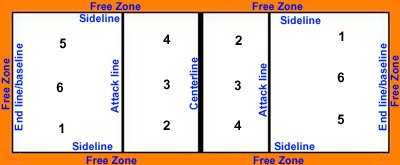
We'll start by talking about the different areas of the court. As you can see in the diagram below, there are six different areas of the court. When numbering off, you start with the number one and goes counter-clockwise around the court, with one number in each of the six spots.
Next, we'll cover the different positions on the court. I wasn't able to find too great of a diagram for this one, but what's below will have to do.
As you can see, the areas are labeled on this court as well, which is very helpful. Area one is called right back. In most rotations, the setter's base would be at this spot. A player's base is like their home on the court, it's the spot where they would be whenever the ball is on the other side of the net, after all the rotation switches have been made. 

Area two corresponds to the right front position. This is where the right side hitter is based. Area three is usually called middle front (unlike center front which is what the diagram calls it) and this is where the middle hitter is stationed. Similarly, area four is known as left front and this is where the left-side, or outside, hitter is based. 

Going to the back row of the court, the next area (area five) is the left back position. Now, the player who has their base here can vary. Without using any substitutions, the other outside hitter would play this spot. However, most teams use substitutions for the back row unless their outside hitters are extremely good passers, so a defensive specialist (a player who is very good at passing and defense in general) or a libero can also play this position. 

A libero is another type of passer, although most people recognize that player by the opposite color jersey she wears. If you don't know much about the libero, don't worry, I'll cover that in an upcoming post. However, if you're just dying to find out now, click here to learn more about the details of all the different positions on the court and what roles they play. 

The last position (area six) is also a tricky one. Again, if no substitutions are used, the other middle front would play this position. If substitutions are used, a defensive specialist or libero would play this position as well. 

Well hopefully that all made sense to you. (There will be a quiz posted later so be ready!) If you have any further questions or would like something better explained, please feel free to comment below!